

Elucidating the Principles of Bacteria–Host Symbiosis through Lipid A
Chemical ecology is a field of research that views diverse biological phenomena between organisms as interactions mediated by chemical compounds. In this project, we extend this concept to interactions between bacteria and their hosts and introduce a new perspective, “bacteria–host chemical ecology,” in which the bacterial glycolipid lipid A serves as a key molecule. From this perspective, we aim to elucidate the molecular mechanisms by which commensal bacteria appropriately modulate host immunity and thereby establish symbiotic relationships with their hosts.
Although lipid A possesses potent immunostimulatory activity, its chemical structure varies considerably among bacterial species. In particular, in symbiotic and parasitic bacteria that establish close relationships with their hosts, the chemical structures and immunological functions of lipid A may have been optimized through coevolution with the host. We chemically synthesize structurally complex and heterogeneous bacterial glycoconjugates, such as lipid A molecules, as pure compounds with well defined structures, and elucidate their structure–activity relationships. We also focus on distinctive lipid A structures found in bacteria adapted to specialized environments, such as acetic acid bacteria, to understand the relationship between environmental adaptation and lipid A structure and to exploit the underlying molecular design principles for the creation of novel immunomodulatory molecules.
FEATURE
Pioneering “bacteria–host chemical ecology” based on the precise chemical synthesis of glycoconjugates
Elucidating the molecular basis of host immune modulation and symbiosis mediated by lipid A from symbiotic bacteria
Structural and functional analysis of lipid A diversified through environmental adaptation, and the creation of novel immunomodulatory molecules
RESULTS
Research progress
Identification of a key immunomodulatory molecule from symbiotic bacterial lipid A
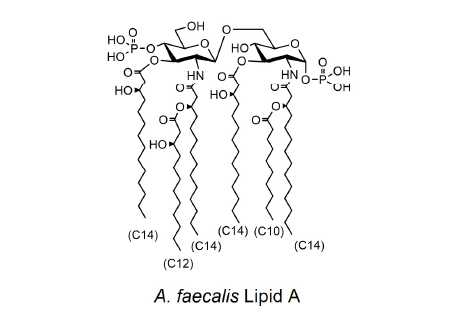
Maintenance of intestinal homeostasis requires finely tuned interactions between the host and bacteria. We focused on Alcaligenes faecalis, a symbiotic bacterium residing in Peyer’s patches, a gut-associated lymphoid tissue, and performed structural analysis of its lipopolysaccharide together with chemical synthesis of its lipid A. Lipid A from A. faecalis exists as a heterogeneous mixture of several structures. By chemically synthesizing each component as a pure compound and comparing their biological activities, we identified a specific lipid A structure that appropriately activates host immunity. This lipid A promotes antibody production, including IgA, which plays an important role in maintaining intestinal mucosal immune homeostasis, without inducing excessive inflammation. These findings suggest that the distinctive lipid A produced by symbiotic bacteria is not merely a bacterial structural component, but may function as one of the molecular mediators that regulate bacteria–host interactions.
Discovery of Acid-Resistant Immunostimulatory Activity in Acetic Acid Bacterial Lipid A
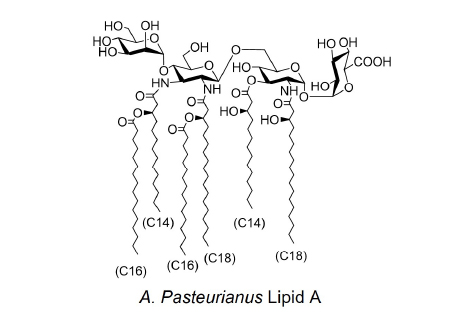
The chemical structures of lipid A have also diversified through bacterial adaptation to different growth environments. We focused on the acetic acid bacterium Acetobacter pasteurianus. Whereas conventional lipid A molecules contain acid-labile glycosyl phosphate structures, lipid A from acetic acid bacteria possesses a distinctive structure containing glucuronic acid. We achieved the chemical synthesis of an unprecedented glucuronic acid-containing lipid A. Functional analysis of the synthetic molecule demonstrated that acetic acid bacterial lipid A is relatively stable under acidic conditions and functions as an “acid-resistant immunostimulatory molecule.
Further development
Investigating the chemical ecology between bacteria and their hosts to establish new principles of immune regulation
Building on the insights obtained from A. faecalis and A. pasteurianus, we will expand our studies to a broader range of bacterial species and elucidate the relationship between structural diversity in lipid A and the regulation of host immunity. We will further investigate how immune regulation by bacterial molecules extends beyond local intestinal homeostasis to influence systemic physiology and nervous system function, thereby advancing our understanding of the molecular mechanisms underlying autoimmune diseases and the gut–brain axis.